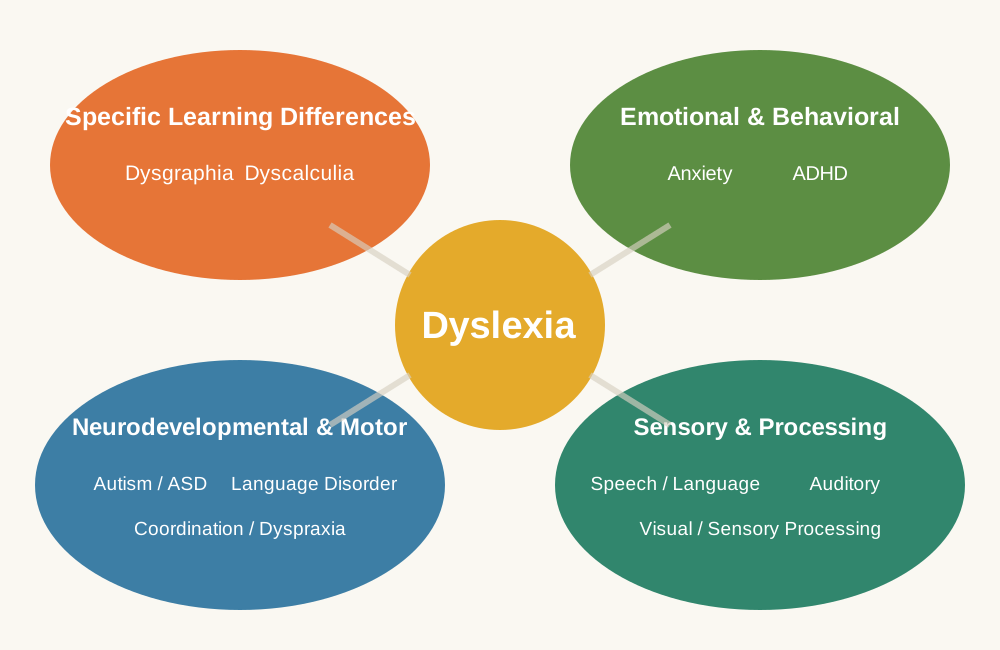
There are several conditions that can occur alongside dyslexia. In the United States, dyslexia is treated as an individual learning difference. In the United Kingdom, they have a somewhat different perspective and model for treating it.
Many times, giving students tools to be able to read helps their dyslexia, and while reading isn't necessarily easy after that, they can definitely accomplish it. However, with other children, there may be a variety of other issues that occur alongside their dyslexia. Each of these may need its own supports, diagnosis, or therapies.
Neurodevelopmental & Learning Differences
These are conditions that commonly co-occur with or overlap dyslexia due to shared cognitive or developmental mechanisms:
- Autism Spectrum Disorder (ASD) — some studies show shared traits and overlaps even if genetic correlation with dyslexia is complex.
- Developmental Language Disorder (DLD) (also called specific language impairment) — trouble with understanding/using spoken language that can contribute to reading/spelling difficulties and often appears alongside dyslexia.
- Developmental Coordination Disorder (Dyspraxia) — motor coordination difficulties frequently co-occur with dyslexia.
- Visual and auditory processing difficulties — not primary visual problems but difficulty interpreting visual information (distinct from vision acuity), or difficulty processing sound information efficiently, which can interact with phonological challenges in dyslexia. Both challenge interpreting sensory input in ways that can complicate reading and language tasks.
- Non-verbal learning disorder — affects visual-spatial and motor coordination skills and is sometimes seen with dyslexia.
- Sensory processing disorder — differences in interpreting sensory information can overlap with dyslexia and other learning challenges.
Cognitive & Executive Function Challenges
These aren't always separate diagnoses but are important correlates that could be shown on your wheel:
- Working memory difficulties — often linked with reading and math struggles.
- Executive function challenges — such as planning, organization, and task switching can accompany dyslexia.
- Attention-Deficit/Hyperactivity Disorder (ADHD) — one of the most commonly co-occurring conditions with dyslexia, involving attention, impulsivity, and executive function challenges. Related article: When Reading Struggles and Attention Issues Overlap: Understanding ADHD in Children With Dyslexia
- Dysgraphia — a specific learning difference affecting writing skills and fine motor control, frequently overlapping with dyslexia. This occurs in quite a few children. Related article: When Reading and Writing Both Feel Hard: A Parent's Guide to Dysgraphia
- Dyscalculia — a difficulty with mathematical reasoning and numeracy, often seen alongside dyslexia.
Mood-Related Co-Occurring Conditions
While not a learning difference per se, research (including rapid reviews from the University of London) indicates that anxiety and other mental-health challenges are more common in children and youth with dyslexia — in part due to the stress of academic demands and ongoing struggle. Beyond learning-specific disorders, research shows links with emotional and behavioral conditions:
- Anxiety disorders — anxiety is more prevalent among individuals with dyslexia, possibly arising from persistent academic stress.
- Conduct disorder (CD) and oppositional defiant disorder (ODD) — some studies find higher rates of these in children with dyslexia.
- Mood disorders — like depression or internalizing disorders, which may correlate with learning stress and challenges.